Carcassonne – Villesèquelande – Tréboul – Castelnaudary
Carcassone
Early in the morning, two of our daughters (we have three and a son), Kathryn and Laura, phoned and reported that they had arrived in Paris. They had decided to treat themselves to a short visit and cruise with us on Catharina Elisabeth, followed by a couple of nights in Paris. The three children that they have between them had been left with their very understanding father and other mother. Both of them have cruised with us before; Laura during 2016 in Flanders and Kathryn in 2023 on the Nivernais and River Yonne.

Together, we had decided that they would get to us by train, originally to meet up in Toulouse – but Carcassonne was on the route of their last train. The trip would involve three separate journeys and should have dropped them at Carcassonne just after midday. Not to be. The latest heatwave was in full swing, and the last set of trains was unable to run due to the heat. This resulted in the cancellation of the entire journey. Fortunately, we were able to reschedule the earlier trains and pick a working, if slower, alternative for the last one. Hot and bothered, exhausted and thirsty after nearly three days of continuous travelling, they arrived at the Carcassonne station late in the afternoon.
Recovered and refreshed the next morning, Kathryn and Laura were sent out to get baguettes and pastries – getting into the local vibe as quickly as possible.

The baguettes were converted into lunches, and other provisions were packed. Then we set off on the four bikes, Lisette and Kathryn on the electric ones, Laura and I under conventional power.

It would be their first visit to this impressive walled town, which we had visited previously on our first trip to France in 2010 – we had really enjoyed that visit and were looking forward to another.

Carcassonne was and is two towns – the residential part in which the port is located, founded in the 13th century, and the walled town up higher across the river Aude. The two towns were in regular conflict centuries before they were combined into a single commune in the 19th century.

Our challenge, or at least those of us using pedal power, was to get up the steep final incline to the walled town, and eventually, that required walking. We began our visit with a walk through the town, thronging with visitors. Obviously, the buildings were all in excellent condition and motor traffic was excluded, so it was pleasant just to walk around.

I found an ice creamery and sampled the Amarena ice cream that I love. But spotted several more ice creameries and with the giggling encouragement of the girls (and a ‘behave yourself’ from Lisette), I indulged in three more. Recorded as a scientific experiment.

Then it was time to visit the fortress. For an additional fee one can enter into the grounds of the castle, study the many informative displays in the rooms and take a walk around the ramparts. We stopped long enough in the shady courtyard to eat our lunch before embarking on the next exploration.

The name of the city is steeped in legend, supposedly one Dame Carcas, widow of the Saracen Balaak, was responsible for the defence of the town during a five-year siege by Charlemagne in the 8th C. She used some unconventional stratagems in frustrating the attackers. Supposedly, late in the siege, she ordered that some of the dwindling supply of wheat be used to fatten their last pig. This pig was then flung over the walls to the army outside. Now convinced that the town had sufficient food that they could afford to waste it on feeding his army, Charlemagne decided to withdraw. As the siege was raised, the town celebrated by ringing (in French ‘to ring’ is sonner) the bells. And so we have Caras-sonner! I was quite pleased that I had sufficient French to immediately appreciate the pun – whether the story is true or not.

The current incredible state of preservation of the walled town and its fortress is down to the initiative of Napoleon III and the expertise and endeavour of Eugène Viollet-le-Duc, the architect who loomed large over the restoration efforts in the 19th century, including the Cathedral of Notre Dame in Paris and the Château de Pierrefonds near Compiègne, which we visited in 2018. The double walls surrounding the town itself are some 3 km long, interspersed with 52 towers.
The walled town is, justifiably, a big tourist attraction, very busy in summer, and the main feature is, of course, the history and fortifications. The best way to experience this is via a walk along the ramparts and walking through various buildings associated with the edifice. Conveniently, much of the information is in French, Spanish and English and provided us with a fascinating insight into the history and workings of the medieval fortress.


The view today:

and looking across some of the ramparts to the Basilica of Saint Nazaire just outside the fortress.

At many points along the tour, there were displays of artefacts, sculptures and other features along with some information. For example, these smooth rocks

were used in a trebuchet,

The displays were extensive, and although we spent over three hours exploring, we could have spent much more time absorbing all the information. (Next visit.) The next stop was outside the fortress walls, the Basilica of Saint Nazaire. Built in the 13th century, it was originally a cathedral, but that status has passed to the cathedral in the main town. The pope (of the time) grants the title of Basilica to an especially important church. The Basilica was extensively refurbished by Viollet-le-Duc in the 1840’s.

The choir was impressive, with the central panel of the stained glass windows dating from 1280.

Jeanne d’Arc was co-located. with a modern tableau, “The Holy Face”.

The cycle back to Catharina was much easier as it was downhill, albeit a different route to that we had taken on the way up. I followed the route on my phone, which took us along a street partially blocked by some police and emergency cars. I snuck past on the pavement, but the three behind me were stopped and reprimanded by one of the police who told them that no one was allowed to pass emergency vehicles. I went back to join them, and, chastened, we found our way back to Catharina on a yet another route.
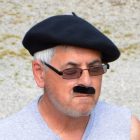
The next day we sent the girls off to shop, explore, eat and drink – generally to be young folk in France. We met them for lunch, me with a new haircut.

The short-term plan was to cruise with the girls as far as Toulouse. They had about 12 days until they had to go back to Paris before heading home a couple of days later. That was long enough for the cruise and to allow some extended stays and some time in Toulouse.

Villesèquelande
We had to wait a bit for an excursion boat to exit the port at Carcassonne, but then we motored into the lock, under the narrow bridge, with the bimini down.

Actually, it probably wasn’t necessary, but it gave the girls a chance to see the gear in operation. We then had a pleasant four and a half hour cruise to the beautifully named Villesèquelande, taking up a lovely mooring just near the village’s bridge.

The village was very quiet. Quite a shock to Kathryn and Laura. The only person we saw as we walked around was a boy doing circuits on a bike. For us, it’s not that unusual to find small towns and villages deserted during the day – sometimes a bit more life in the evening. The town centre was dominated by a “Sully” tree, the Orm de Sully (Elm of Sully), the third of these we have come across in our travels.

Again, the trees were planted all around France as an initiative by Maximilien de Béthune, Duke of Sully in the early 17th century to encourage locals to gather there and debate community matters. This particular elm tree is an original and is over 400 years old. A little. further around, the local wine co-operative had decorated the cellar shed with a monumental fresco. Unfortunately, the cellar was not open.

We then reintroduced the girls to afternoon nibbles and drinks under the bimini, and entertained ourselves with a swim in the canal

and, in turn, were entertained by a passerby and his dog that was having a great time leaping into the canal to retrieve a stick. Dinner, of course was onboard Catharina, and then we had a relaxed evening, eating, drinking and playing Rummikub® – just us and the simple pleasures of a barge, the canal and the quiet of a small French village.

Tréboul
Just before we cast off, I took one of my favourite photos of the season, capturing Catharina, her crew and an iconic Midi bridge.

By now, we were setting the girls to work. Here’s a representative process. I would land Catharina near the écluse and drop Lisette and Laura off to walk up to the lock. Kathryn, meanwhile, would take up position at the bow to deliver the forward rope. As the automatic system was almost always on the other side of the écluse to the one we usually moor against, Laura would work the automatic controls

and start the sequence to empty the lock (if required), and open the gates. Lisette would take up a position on the other side to take the ropes. I’d bring Catharina in, and after I had entered, Kathryn would pass the bow and then the stern warps to Lisette to attach to the bollards. Laura would then trigger the fill cycle, and once Catharina made it to the top, everyone clambered back aboard, and we were off. Both girls took turns providing very welcome assistance, although Kathryn decided she loved the blue-tooth headsets, so she was often the one to operate the lock.

Another four-hour-plus cruise brought us to the small village of Tréboul, where we moored just downstream from the écluse. There were some guys fishing just ahead of us, but we had enough room to tie up without interfering with their fun.

Castelnaudary
The cruise to Castelnaudary was going to be one of the more challenging of the season. Over the 13 kilometres, there were to be six single ecluses followed by a triple, a double and a quadruple taking us into the town. Both Laura and Kathryn helped Lisette with operating the locks, passing ropes and helping carry them from lock to lock up the various staircases. Having some extra crew allowed for some photos we couldn’t take earlier.

This had become our standard mooring technique, going up (montant), in these curved locks . Using the mid-ships bollards, Lisette running tension on the forward warp, trying to keep the bow into the wall, and Ian working the rearward bollard, tensioning the middle of the rope and pulling in any slack, trying (not always successfully) to keep the stern from nudging the vessel beside us.
We missed recording our climb up the Fonserannes staircase, but we did have the dash cam running this time and here is a sped-up (20x) version of this bit of locking. Check out the crowds again – they seem to set themselves up with drinks and snacks, watching the antics of boats in and out of the locks. We did most of these locks along with a small hire boat, watched by tourists and townspeople. But as we now had over 60 Midi locks behind us, we felt we should have made a good impression. (Lisette: And before any experienced crew says anything – the only way I could hold the ropes while off board was to add a turn around the bollard to prevent the rope slipping right out of my hands while the water gushed in. Of course, I had to be extra vigilant to make sure the rope did not get crossed over itself, but this is less of a problem when a boat is going up than when it is going down.)

It was a stiff seven-hour cruise, and we ended up confused and lost in the Grand Bassin of Castelnaudary, looking for the moorings. A quick bit of research by Lisette, and we found that we needed to cross the basin and pass under another low bridge to get to the port proper. This we did and were greeted by Odile, the capitaine. Well-regarded along all the Midi, known as one of the friendliest and most helpful of the port captains, she helped us moor up, gave us directions and dashed off to chide some kids on scooters that she thought were riding dangerously. She told us she had seen our boat at Villesqèlande as our mooring was beside her weekend home, and she said she could see (and probably hear) how much fun we were having.

We took a stroll around the small but sweet town centre. Walking up over the bridge ahead of us we saw several boats we knew, but no-one was on board at that time. Checking out the town itself we found ourselves caught in a brief but intense rainstorm. I raced back to Catharina to close any open portholes, while the girls and Lisette took shelter in a bar and had a drink while we waited for the rain to pass. Dinner on board was confit of duck and had nice with caramelised citrus sauce, haricot verts and potatoes.



One Response
How lovely to have your girls with you! I bet they thoroughly enjoyed it too. I haven’t been to Castelnaudary, but it seems to be popular with several WOBs members. What glorious weather you had as well. Sitting here in the unseasonably cold May weather we’re having in the Netherlands, I am feeling very nostalgic about sunshine and warmth!